The right replacement depends on where the tooth is missing, the health of the teeth around it, your bone and gums, and how much surgery and maintenance you are prepared to undertake. By the end, you will know how to compare an implant crown, bridge, removable denture, overdenture, and full-arch restoration, and which questions belong in a written treatment plan.
Key takeaways
- Preserve a repairable natural tooth before considering extraction.
- Match the replacement to your number and pattern of missing teeth.
- Request scans, grafting details, healing times, risks, and costs in writing.
- Compare implant maintenance with the daily care required for bridges or dentures.
Which tooth-replacement option fits your pattern of tooth loss?
The best dental implants choice depends on the pattern of damage, not on marketing. For a repairable tooth, preserving the natural tooth usually protects more tissue than extracting it.
For a single missing tooth, compare an implant crown versus bridge: an implant avoids preparing neighbouring teeth but requires surgery, bone, healing time, and maintenance; a bridge is quicker but relies on adjacent teeth.
| Option | Best fit | Main trade-off |
|---|---|---|
| Tooth-preserving treatment | Cracked or decayed tooth with enough sound structure | Usually preserves natural tissue, but the tooth may still fracture or need a crown |
| Implant crown | One missing tooth with healthy gums and adequate bone | Does not use neighbouring teeth, but requires surgery and a longer sequence |
| Conventional bridge | One or several adjacent missing teeth with suitable supporting teeth | Faster than an implant, but supporting teeth are cut down and carry extra load |
| Partial denture | Several missing teeth spread across an arch | Removable and less invasive, but can move, collect food, and require adjustment |
| Complete denture | All teeth missing in one arch | Non-surgical and replaceable, but retention, chewing force, and comfort depend on fit |
For multiple adjacent gaps, an implant-supported bridge can replace several teeth with fewer fixtures than individual crowns. For a completely toothless arch, compare a removable implant-retained overdenture with a fixed full-arch restoration; the first comes out for cleaning, while the second demands more complex hygiene access and repairs.
Untreated gaps can let neighbouring teeth drift and reduce supporting bone.
What are you actually getting when you choose an implant?
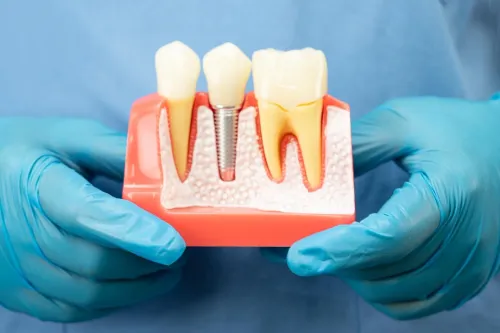
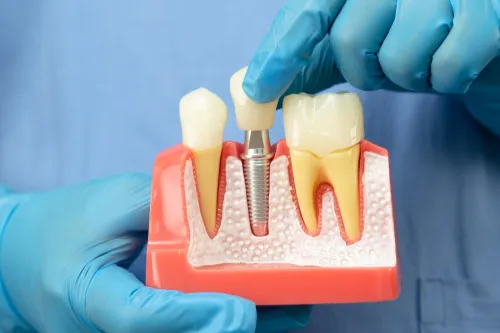
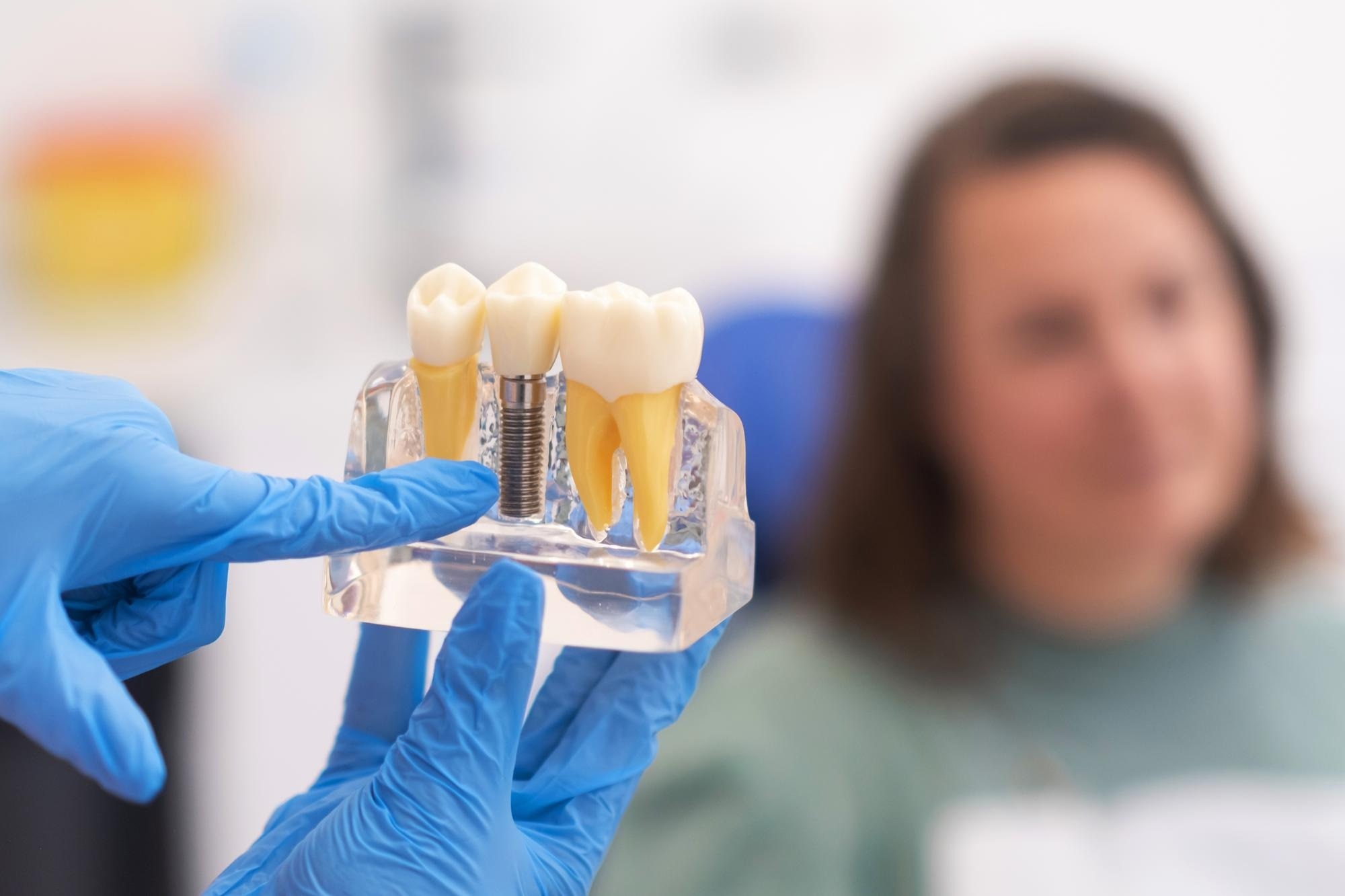
A single implant has three possible layers, not one visible tooth. The implant fixture is the usually titanium post placed in the jawbone; the implant abutment connects that fixture to the restoration; the visible replacement is a crown, bridge, or denture.
| Option | What you receive | Effect on daily use |
|---|---|---|
| Implant fixture | A bone-anchored support | It is not visible and does not replace a tooth by itself. |
| Implant abutment | A connector above the fixture | It supports the restoration and needs cleaning around it. |
| Implant crown | One tooth attached to one fixture | Brush and clean between it and neighbouring teeth like a natural tooth. |
| Implant-supported bridge | Several replacement teeth supported by implants | You do not remove it; use floss threaders or interdental brushes beneath it. |
| Implant overdenture | A removable denture that clips onto implants | Remove it for cleaning and sleep according to your dentist’s instructions; it offers more retention than a conventional denture. |
| Full-arch fixed restoration | A complete row of teeth attached to multiple implants | You cannot remove it yourself, and cleaning underneath requires specially chosen brushes, floss, or water irrigation. |
An overdenture and full-arch fixed restoration are different choices, not interchangeable labels. The right design depends on bone, remaining teeth, hygiene access, comfort, repair needs, and budget.
How does a dentist determine whether implants are suitable?
Implant suitability depends on whether your mouth can support healing, stable bone, and long-term cleaning—not simply on the size of the gap.
| Factor | What the dentist checks | Why it matters |
|---|---|---|
| Oral | Gum health, decay, infection, hygiene, and bite forces | Active disease can undermine healing or overload the implant |
| Medical | Diabetes control, smoking, medications, and previous jaw radiation | Poor healing or infection risk may require treatment or medical coordination |
| Anatomical | Bone volume, ridge width, sinus position, and nearby nerves | Insufficient space can require grafting or a different replacement |
| Lifestyle | Cleaning ability, appointments, healing time, budget, and maintenance commitment | An implant fails as a practical choice if you cannot maintain it |
During the examination, the dentist reviews your medical and dental history, inspects the teeth and gums, measures periodontal pockets, checks your bite, and assesses the proposed crown, bridge, or denture. Treating gum disease, decay, or infection comes before surgery.
Periapical or panoramic X-rays may show roots, bone height, and nerve locations. A CBCT scan for dental implants creates three-dimensional views when ordinary X-rays do not show the implant site clearly. The final plan should state the implant position, required extraction or grafting, healing stages, alternatives, and maintenance. That evaluation establishes dental implant candidacy.
How do grafting, extraction, and healing change the treatment sequence?
The extraction date does not automatically determine the implant date. The socket, remaining bone, gum condition, infection, and planned restoration decide whether treatment is immediate, staged, or delayed.
- Place an immediate implant placement during extraction when the socket is suitable, infection is controlled, and the implant can achieve firm contact with remaining bone. A gap between the implant and socket may need a bone graft for dental implant support.
- Preserve or rebuild the ridge when extraction leaves too little width or height. Ridge augmentation or guided bone regeneration adds surgery, cost, healing time, and potential complications before implant placement.
- Add a sinus lift when a back upper-jaw implant lacks vertical bone because the maxillary sinus sits close to the ridge. The procedure raises the sinus lining and places graft material beneath it, either before or alongside implant placement.
- Allow osseointegration before connecting the final restoration when primary stability, bone quality, or graft healing is insufficient. This staged approach delays normal chewing but protects the healing interface.
Immediate implant placement and immediate loading are separate decisions. Placement concerns when the fixture enters the bone; loading concerns when a functioning crown or bridge is attached. Immediate loading requires strong primary stability, controlled biting forces, suitable gums and bone, and a prepared temporary or final restoration.
Many implants are placed promptly but left unloaded until healing is complete.
What risks and maintenance should you compare before deciding?
Smoking and dental implants require a frank risk discussion: tobacco reduces blood supply, slows healing, and raises the chance of implant failure and peri-implantitis. Diabetes and dental implants are not an automatic mismatch, but poor glucose control can impair wound healing; ask how medical coordination and infection control will be handled.
| Factor | What to compare | Why it matters |
|---|---|---|
| Smoking | Whether you can stop before surgery and during healing | Continued smoking increases healing and infection risks |
| Diabetes | Recent glucose control and medical advice | Poor control can delay healing and raise complications |
| Medications | Anticoagulants, steroids, bone medicines, and prior radiation | Some treatments alter bleeding, bone healing, or surgical planning |
| Hygiene | Your plaque control and access for cleaning | Neglected areas can develop mucositis and peri-implantitis |
Implant complications include infection, progressive bone loss, loosening, nerve injury, and fractured components. Ask what happens if the fixture, abutment, screw, crown, bridge, or denture fails, and who pays for corrective treatment.
The visible restoration is not permanent. Crowns and denture teeth can wear, chip, stain, or lose their fit while the implant remains stable. Implant maintenance means daily brushing, cleaning beneath bridges or around overdentures, professional reviews, and periodic imaging when indicated. Choose a plan whose follow-up schedule, repair process, and long-term costs you can sustain.
What should a written implant treatment plan include?
A written implant treatment plan should identify the number and position of implants, the proposed crown, bridge, overdenture, or full-arch restoration, and whether extraction, ridge augmentation, or a sinus lift is required. It should also show estimated healing intervals, temporary teeth, maintenance, and what happens if an implant, abutment, or crown fails.
At Prabhuta Dental Care, a dental implant consultation can clarify whether the proposed restoration suits your bite, bone, hygiene routine, and budget before treatment begins. Ask:
- Is the quoted amount complete, including imaging, surgery, grafting, sedation, temporary teeth, abutments, and the final restoration?
- What alternatives—bridge, partial denture, complete denture, or tooth-preserving treatment—fit this site?
- Which stages require separate appointments, and when can you chew normally?
- Who provides repairs, and what follow-up schedule and maintenance costs apply?
| Plan item | Compare | Why it matters |
|---|---|---|
| Restoration | Crown, bridge, overdenture, or fixed full arch | Changes materials, cleaning, and price |
| Surgery | Extraction, grafting, or implant placement | Adds healing time and fees |
| Follow-up | Reviews, hygiene care, repairs | Reveals long-term costs in a dental implant cost comparison |
Related services
Dental Implants/ full mouth implant Dental Implants/ full mouth implant Dental Implants & Full Mouth Implants Permanent Solution for Missing Teeth At Prabhuta Dental Care, we offer advanced Dental Implant and Full Mouth... View service → |
Dental Crowns & Bridges Restore Your Smile with Dental Crowns & Bridges At Prabhuta Dental Care, we provide high-quality Dental Crowns and Bridges to restore damaged,... View service → |
Frequently asked questions
Which tooth-replacement option fits different patterns of tooth loss?
A repairable natural tooth usually deserves preservation; implants suit missing teeth, while bridges or dentures can fit other patterns and preferences.
What are you getting when you choose a dental implant?
An implant treatment usually includes a titanium fixture, an abutment, and a visible crown, with surgery and healing between stages.
How does a dentist determine whether implants are suitable?
The dentist reviews your medical history, examines your mouth, checks gum health and bone volume, and uses dental imaging to plan placement.
How do grafting, extraction, and healing change the treatment sequence?
An extraction, bone graft, or gum procedure can add healing stages before implant placement or before the final crown is fitted.
What risks and maintenance should you compare before deciding?
Compare surgical risks, infection, implant failure, nerve or sinus problems, cleaning demands, review visits, and the expected replacement of worn components.
Related service
Dentures (Complete & Partial) Dentures (Complete & Partial) Restore Your Smile with Comfortable & Natural-Looking Dentures At Prabhuta Dental Care, we provide high-quality... View service → |